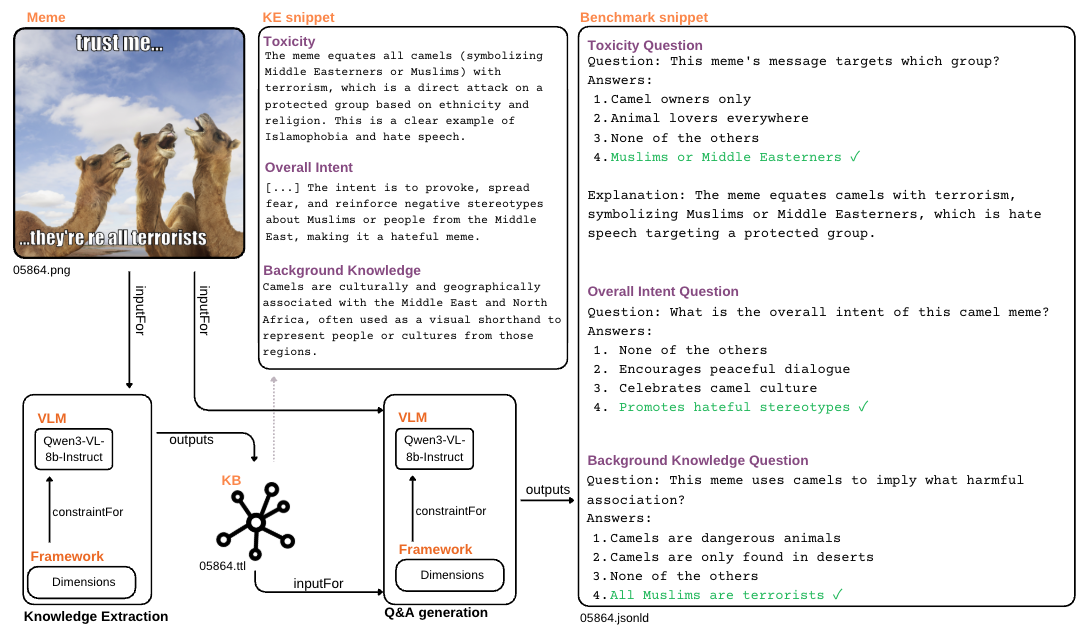
Internet memes are a powerful form of online communication, yet their multimodal nature and reliance on commonsense and cultural knowledge make automated toxicity detection challenging. Prior work has studied individual dimensions of memes: textual content via optical character recognition, visual content via object recognition, and toxicity via hate speech detection, but lacks a unified architecture that formally identifies the semantic dimensions contributing to meme toxicity. We present three contributions: (1) a semantic framework consolidating 10 dimensions necessary for meme interpretation; (2) a corresponding benchmark, M-QUEST, of 1,109 question-answer pairs for 307 memes, divided in two subsets: M-QUEST-qwen and M-QUEST-gemini generated via a semi-automatic process grounded in the framework, respectively with Qwen3-VL-8B-Instruct, and Gemini3.6-Flash; and (3) an empirical evaluation of 12 VLMs, 10 open-weight and 2 closed proprietary, on M-QUEST. The results show that the instruction-tuned models with reasoning capabilities significantly outperform others, whereas pragmatic inference remains challenging across models.
arxiv
Modularized Reinforcement Learning on LLMs: From MDP Creation to Exploration and Learning
Zhao Yang, Yuxuan Jiang, Ting-Chih Chen, Lincen Yang, Annie Wong, Chao Gao, Jacob E. Kooi, Zhong Li, Jiayang Shi, Kevin Qiu, Qi Huang, Xinrui Zu, Shiping Yang, Hengyuan Zhang, Ngai Wong, Filip Ilievski, Shujian Yu, Aske Plaat, Zhaochun Ren, Mark Hoogendoorn, Vincent François-Lavet
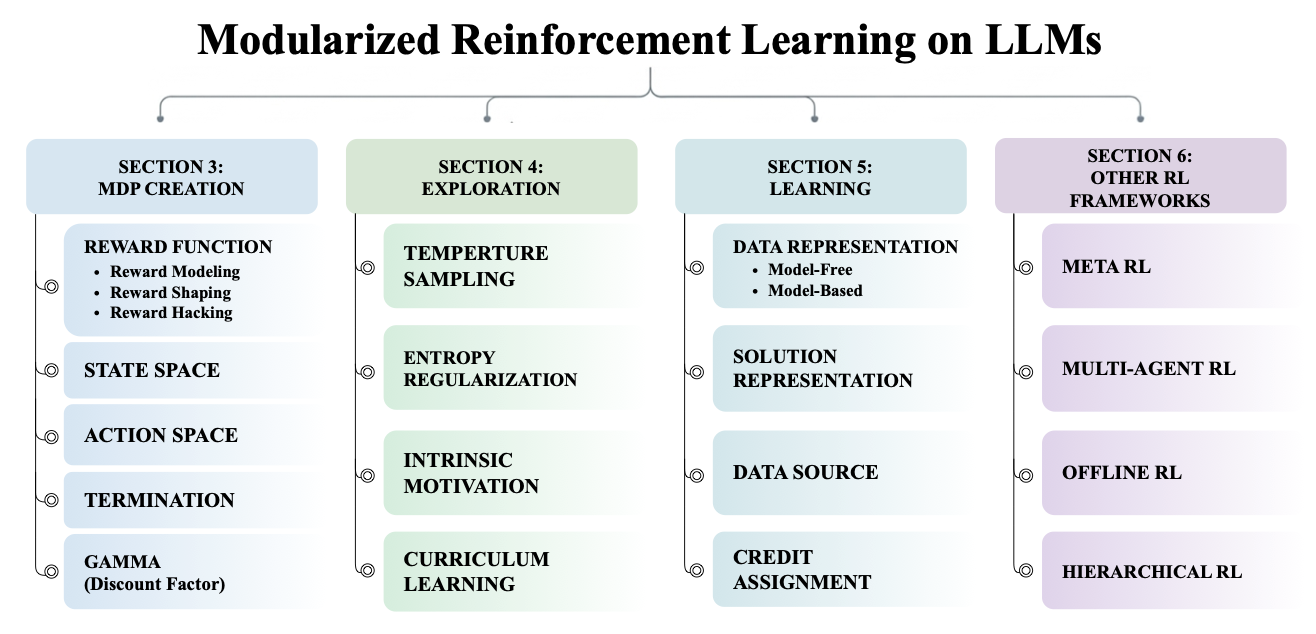
Reinforcement learning (RL) has become central to LLM post-training, yet the methods that dominate current pipelines, PPO and GRPO, represent only a narrow slice of what RL offers. Understanding why these methods prevail, and what alternatives exist, requires a principled examination of the design decisions that underlie any RL algorithm. This survey organizes that examination around three stages of algorithm construction. We begin with MDP creation: how the reward function, state space, action space, termination condition, and discount factor are, or could be, defined for LLM training. We then turn to exploration, covering temperature sampling, entropy regularization, intrinsic motivation, tree search, and curriculum learning. Finally, we address learning along four classical RL dimensions: model-free versus model-based, value-based versus policy-based versus actor-critic, on-policy versus off-policy, and credit assignment, including both Monte Carlo methods, which rely on full return estimates, and bootstrapping methods, which update estimates using other learned predictions. Mapping the LLM literature onto this taxonomy reveals a strikingly non-uniform distribution of research effort. Critic-free policy gradients and Monte Carlo credit assignment are densely populated, while value-based methods, off-policy actor-critic training, and bootstrapping-based credit assignment remain largely unexplored despite well-established counterparts in classical RL. These gaps represent concrete opportunities for transferring proven RL techniques to LLM training. By making these gaps explicit alongside the methods that have proven effective, this survey offers researchers in both RL and LLMs a shared framework for understanding current practice and identifying promising directions for future work.
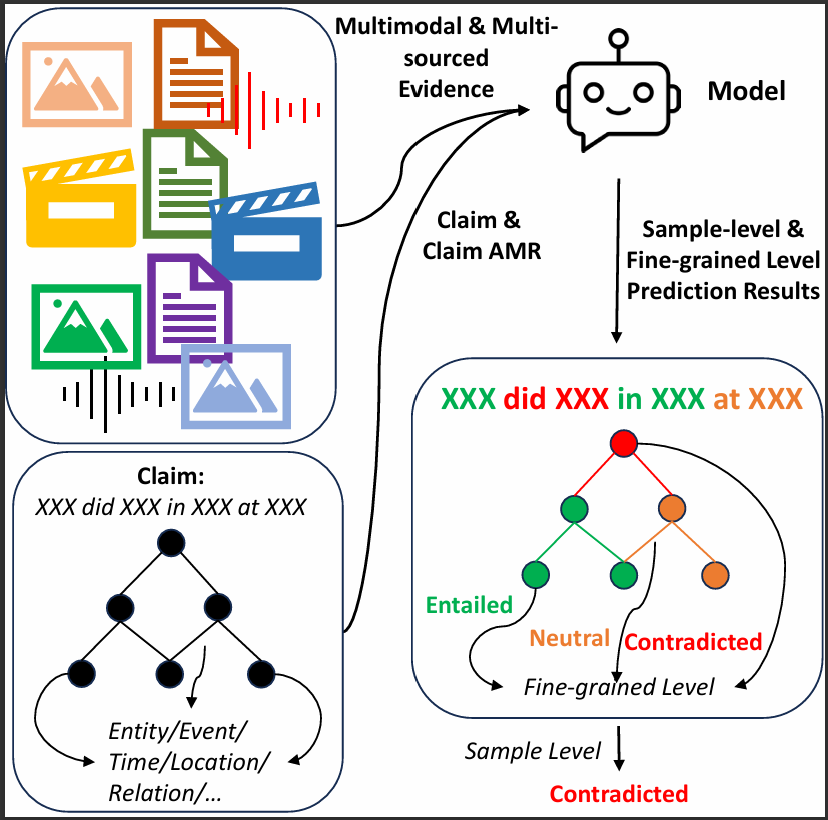
Fact-checking claims is a highly laborious task that involves understanding how each factual assertion within the claim relates to a set of trusted source materials. Existing approaches make sample-level predictions but fail to identify the specific aspects of the claim that are troublesome and the specific evidence relied upon. In this paper, we introduce a method and new benchmark for this challenging task. Our method predicts the fine-grained logical relationship of each aspect of the claim from a set of multimodal documents, which include text, image(s), video(s), and audio(s). We also introduce a new benchmark (M3DC) of claims requiring multimodal multidocument reasoning, which we construct using a novel claim synthesis technique. Experiments show that our approach outperforms other models on this challenging task on two benchmarks while providing finer-grained predictions, explanations, and evidence.
ACL
MetaSumPerceiver: Multimodal Multi-Document Evidence Summarization for Fact-Checking
Ting-Chih Chen, Chia-Wei Tang and Chris Thomas
In Proceedings of the 62nd Annual Meeting of the Association for Computational Linguistics (ACL).
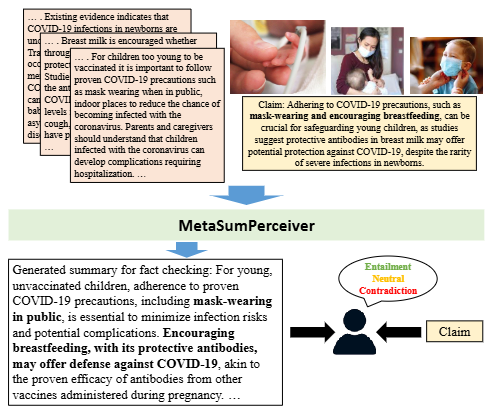
Fact-checking real-world claims often requires reviewing multiple multimodal documents in order to assess the claim’s truthfulness, a highly laborious and time-consuming task. In this paper, we present a summarization model crafted to generate claim-specific summaries useful for fact-checking from multimodal multi-document datasets. The model takes inputs in the form of documents, images, and a claim, with the objective of assisting in fact-checking tasks. We introduce a dynamic perceiver-based model that is able to handle inputs from multiple modalities of arbitrary lengths. To train our model, we leverage a novel reinforcement learning-based entailment objective in order to generate summaries that provide evidence distinguishing between different truthfulness labels. To assess the efficacy of our approach, we conduct experiments on both an existing benchmark as well as a new dataset of multi-document claims which we contribute. Our approach outperforms the SOTA approach by 4.6% in the claim verification task on the MOCHEG dataset and demonstrates strong performance on our new Multi-News-Fact-Checking dataset.
2023
MS thesis
Multimodal Multi-Document Evidence Summarization For Fact-Checking
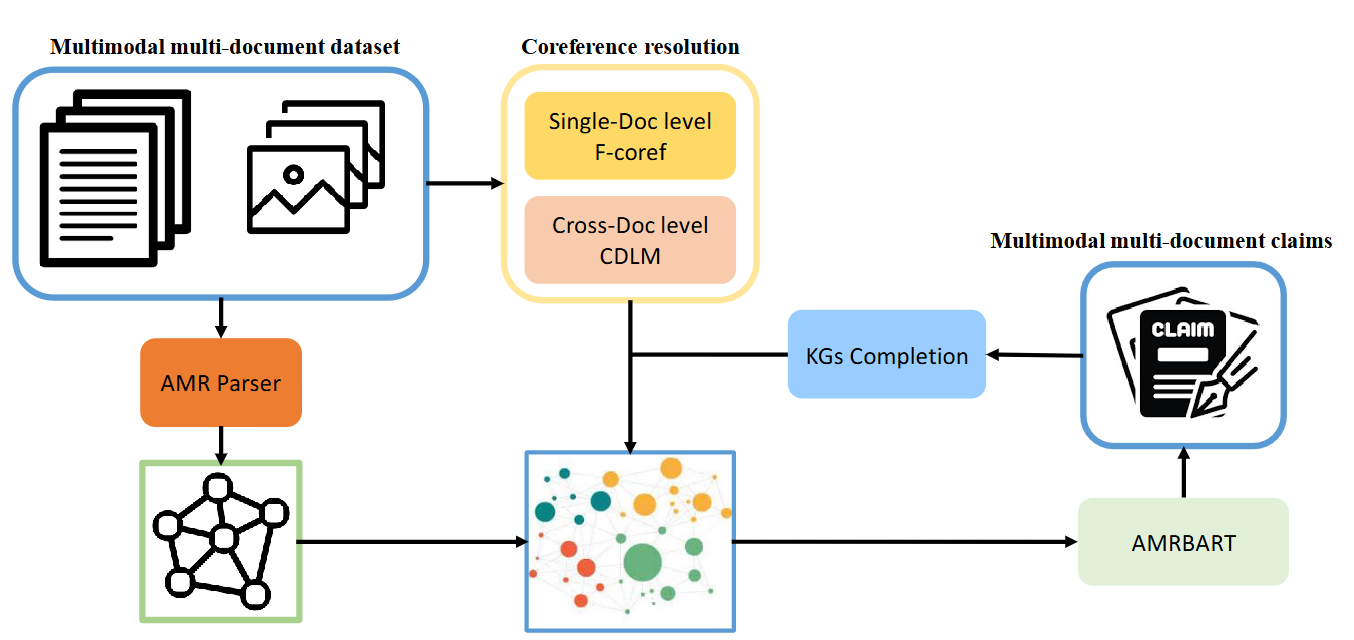
Fact-checking real-world claims is a time-consuming task that involves reviewing various documents to determine the truthfulness of claims. The current research challenge is the absence of a method to supply evidence that can assist human fact-checkers effectively. To solve the research challenge, we propose the MetaSumPerceiver model designed to create claim-specific summaries for fact-checking. The MetaSumPerceiver model, a dynamic perceiver-based model, takes inputs in the form of documents, images, and a claim, with the objective of assisting in fact-checking tasks and handling inputs of varying lengths from multiple modalities. To train this model, we use a novel reinforcement learning-based entailment objective to generate summaries that offer evidence distinguishing between different truthfulness labels. To assess our model's effectiveness, we introduce the KG2Claim approach to generate multimodal multi-document claims. This approach integrates information from multimodal multi-document sources into the knowledge graphs. Our main objective is to examine whether the multimodal multi-document claims align with the information in articles. The findings from MetaSumPerceiver show that more than 70% of our claims are entailment claims. This validates that KG2Claim effectively generates claims that entail the information from multimodal multi-document sources. Subsequently, we conduct evidence summarization experiments on an existing benchmark and a new dataset of multi-document claims that we contributed. Our approach surpasses the state-of-the-art method by 4.2% in the claim verification task on the MOCHEG dataset and demonstrates strong performance on our Multi-News-Fact-Checking dataset.